AI-Powered Customer Support Workflow
A complete end-to-end customer support workflow designed in Miro — not a deployed product, but a production-ready workflow diagram specifying how AI could handle routine support tickets autonomously while routing edge cases to human agents intelligently.
The problem
Customer support at volume has a consistent failure mode: routine tickets that could be resolved instantly get queued behind complex ones, wait times grow, customers get callbacks they didn't want, and agents spend most of their time on work that didn't need them. Meanwhile, novel cases that genuinely require human judgment don't get prioritized clearly. The design brief asked for an AI-augmented support workflow that addressed this directly — handle routine tickets end-to-end without human involvement, route genuinely complex cases to agents with priority signaling, and ensure no ticket closes until the customer confirms resolution.
The workflow
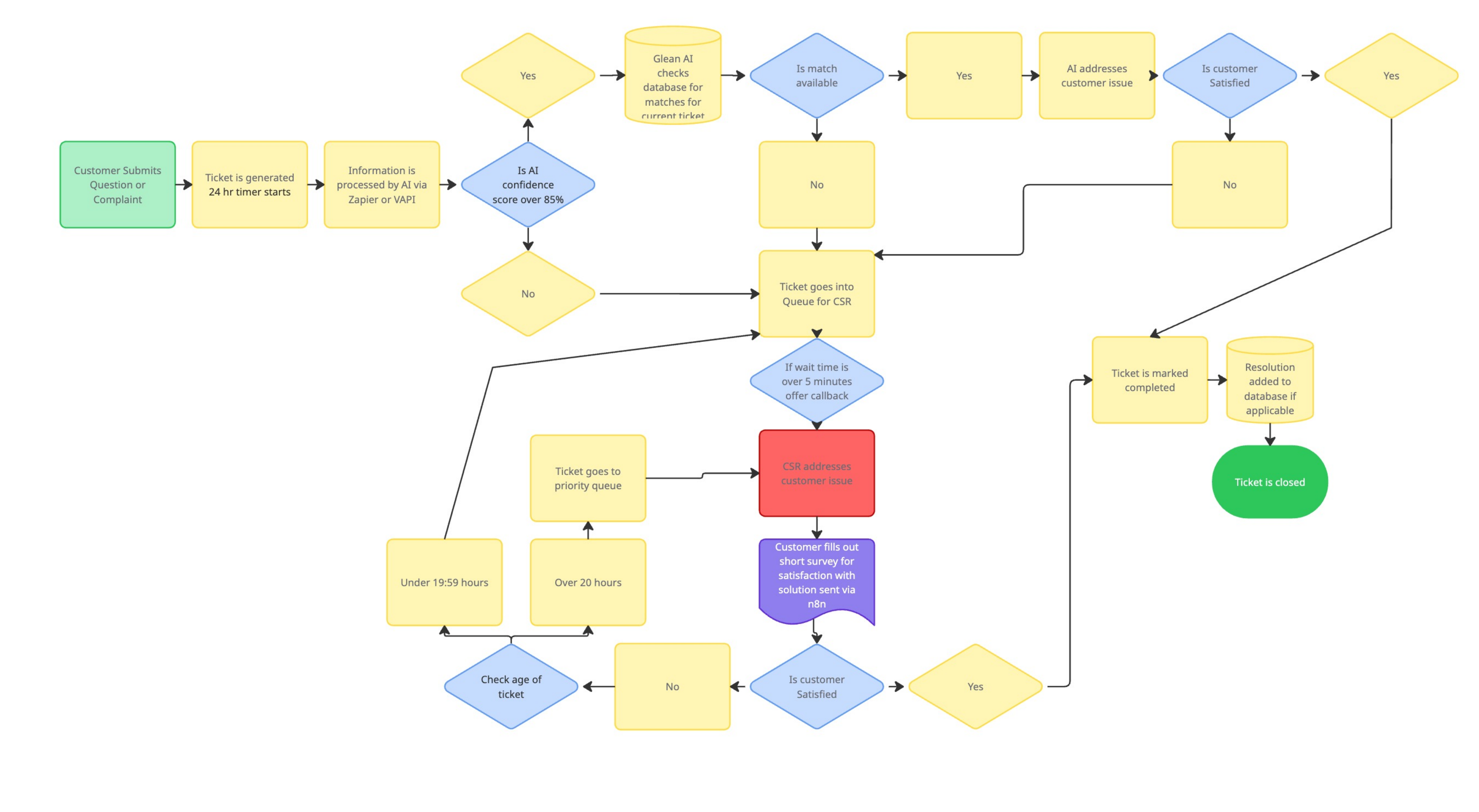
Entry: A customer submits a question or complaint. A ticket is generated and a 24-hour timer starts. The ticket information is processed by AI via Zapier or VAPI. Gate 1 — AI confidence score over 85%: The AI evaluates the ticket. If confidence is 85% or above, the ticket routes to the automated resolution path. If confidence is below 85%, it routes immediately to the CSR queue — no automated attempt on tickets the AI isn't confident about. Automated resolution path (confidence ≥ 85%): Glean AI checks the knowledge database for matches to the current ticket. If a match is found, AI addresses the customer issue directly. If the customer is satisfied: the ticket is marked completed, the resolution is added to the Glean database if applicable, and the ticket is closed. If the customer is not satisfied: the ticket routes to the CSR queue for human handling. If no knowledge base match is found, the ticket routes to the CSR queue. CSR queue: Tickets in the CSR queue trigger a wait time check. If the wait exceeds 5 minutes, the system offers the customer a callback — managing expectations proactively rather than silently. A CSR addresses the issue. A short satisfaction survey is sent via n8n. If the customer is satisfied: ticket marked completed, resolution added to database if applicable, ticket closed. If the customer is not satisfied: the ticket age is checked — under 19:59 hours returns to the CSR queue for another attempt; over 20 hours escalates to priority queue, ensuring long-running unresolved tickets surface to the front of the line rather than aging out silently. Closure rule: No ticket closes until the customer confirms satisfaction — on either the AI path or the CSR path. This is a hard requirement built into the workflow design, not a soft recommendation. Learning loop: Resolutions are added to the Glean knowledge database when applicable. Each resolved ticket makes the knowledge base more complete, improving the automated resolution rate over time without manual curation.
Workflow diagram
Design decisions worth noting
The 85% confidence threshold
A lower threshold would attempt automation on more tickets but produce more unsatisfying AI responses. A higher threshold would push more tickets to CSR unnecessarily. 85% was chosen as a starting point — in production this would be calibrated against actual ticket data and resolution satisfaction rates.
Four tools, four jobs
Zapier/VAPI handle AI processing and ticket routing. Glean handles knowledge base lookup and database writes. n8n handles satisfaction survey delivery. Each tool is scoped to what it does well rather than one tool doing everything — the design is intentionally modular.
Age-based priority escalation
The 20-hour threshold prevents tickets from sitting unresolved indefinitely. A ticket that hasn't been resolved in 20 hours has already failed normal queue processing — it needs a different path, not more of the same. Priority queue escalation makes that explicit.
The callback offer
Offering a callback at 5 minutes of wait time is a small design detail with meaningful customer experience impact. It converts a passive wait into an active choice, which reduces perceived wait time frustration without requiring additional staffing.
Benefits
- 85% confidence gate prevents the AI from attempting tickets it isn't confident about — bad answers are avoided rather than apologized for
- Four tools, four jobs — Zapier/VAPI for intake and routing, Glean for knowledge lookup and writes, n8n for satisfaction surveys; each scoped to what it does well
- Age-based priority escalation at 20 hours surfaces long-running unresolved tickets instead of letting them age out silently
- Callback offer at 5 minutes converts passive waiting into an active customer choice — reduces frustration without additional staffing
- Hard closure rule: no ticket closes without customer-confirmed satisfaction on either path
- Learning loop adds resolutions back to the Glean database, improving automated resolution rate over time without manual curation
Honest limitations
this is a design, not a deployment. The workflow exists as a Miro diagram. No code was written, no APIs were connected, no tickets were processed. The design is production-ready in intent — the tool choices are real, the logic is implementable — but it hasn't been tested against actual support volume or validated against real customer behavior. The 85% confidence threshold is untested. In practice, the right threshold depends entirely on the ticket mix, the quality of the knowledge base, and the cost tolerance for unsatisfying AI responses vs. unnecessary human escalation. This would need calibration against real data before a production deployment. Glean knowledge base quality is assumed. The automated resolution path works well only if the knowledge base is complete and well-maintained. A sparse or outdated database pushes more tickets to CSR regardless of the confidence threshold.
What's next
build the Zapier/VAPI ticket intake and confidence scoring step, connect the Glean API for knowledge base lookup, implement the n8n satisfaction survey flow, test the confidence threshold against sample ticket data and calibrate, and define the database schema for resolution logging and the conditions under which a resolution is added.