HELIOS
A personal knowledge system that treats trust as an engineering problem — where every external claim an AI makes is scored, sourced, and shown.
PROBLEM
An LLM that 'can look things up' is not the same as a system you can trust. There's a meaningful gap between a model that pulls from anywhere on the open web and a system that reasons over a known-good corpus plus a named, vetted set of outside sources. The first is convenient and impossible to audit. The second is the thing you'd actually want making claims you rely on. The design goal was to preserve a curation guarantee — a defense against data poisoning and low-quality sources — while still letting the system consult the outside world when your own notes fall short. That meant building a trust boundary: a governed layer that decides where the system may look beyond your material, and under what constraints, with the source of every external claim visible and traceable. If you can't see which part of an answer came from your own universe versus the outside — and trace it back — the trust boundary is decoration. Provenance on every external claim is non-negotiable.
SOLUTION
Five subsystems, one mental model: eyes, brain, hands, trust-boundary, lock. The architecture is deliberately named so each part has one job. Two are live and functional; the trust layer is built and in validation; the execution layer is a deliberate placeholder for a later iteration. ORION — The eyes A 3D knowledge map. Notes cluster by meaning using an affinity-weighted force layout — related concepts drift together, so structure becomes something you can see and fly through rather than a hierarchy you memorize. Functional · ~3 galaxies · ~63 nodes
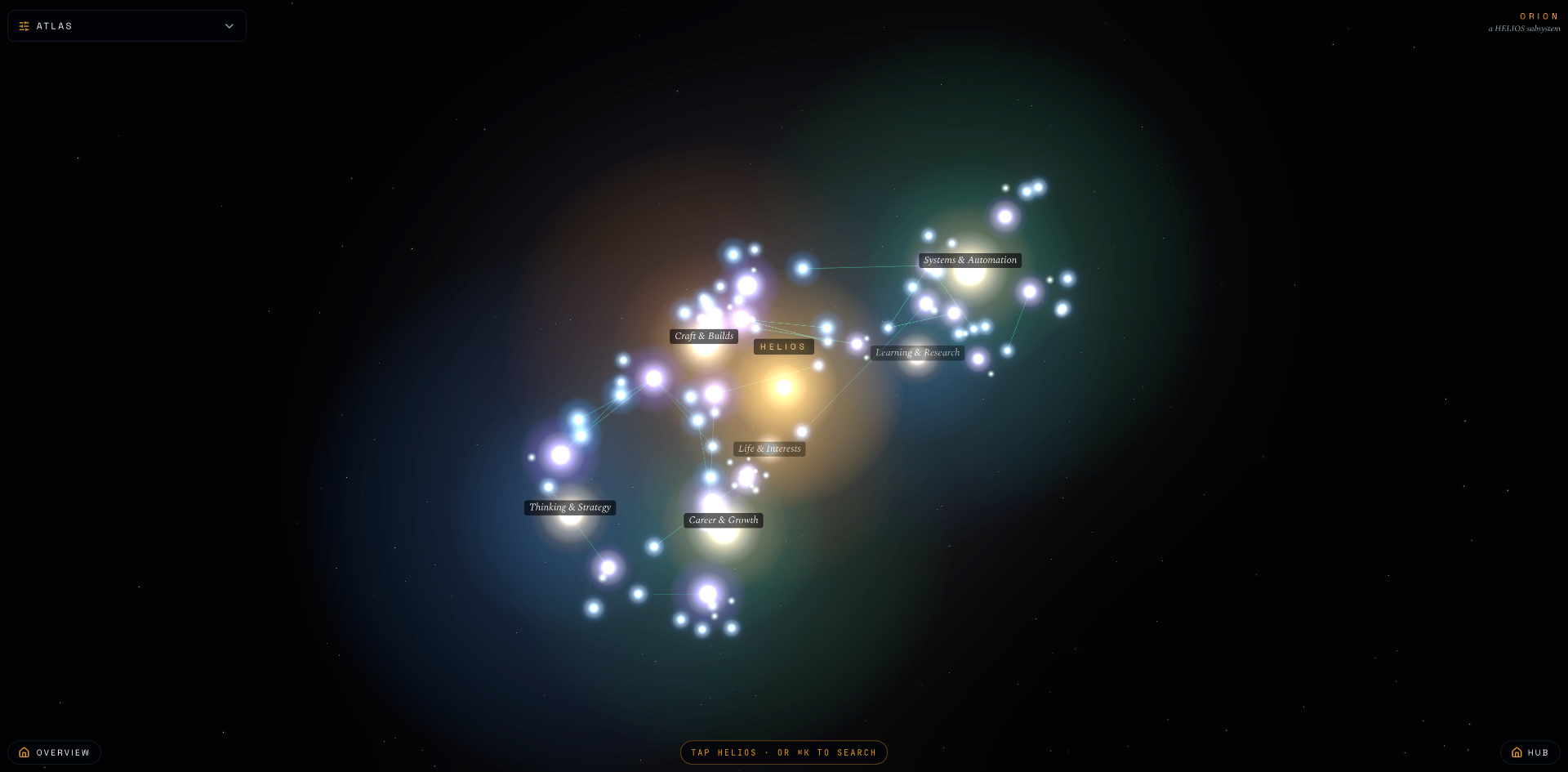
ECHO — The brain The conversational layer and landing surface. You ask a question; it retrieves relevant material by meaning rather than keywords and answers with source chips attached. Wired end-to-end to a retrieval-augmented generation pipeline. Live · answers with provenance

HERMES — The trust boundary The governance layer that scores how much to trust an outside source and how well a given claim is corroborated. The heart of the project — detailed below. Backend built · in validation HEPHAESTUS — The hands The execution layer — the ability to act, not just know and show. Kept as a visible-but-dormant placeholder; the architecture was intentionally left execution-capable so it can be built later without restructuring. Deferred · architecture reserved ARGUS — The lock The security and permission gate — authentication, locked-down access rules, no client-exposed keys. The last checkpoint before anything is published. Release gate · planned THE DATA MODEL UNDERNEATH The guiding principle is the map versus the territory: a curated layer of nodes you navigate (hundreds), sitting on top of a much larger body of embedded content those nodes point into (potentially millions of chunks). The map stays legible; the depth is something you drill into rather than render as noise. Every node carries graded affinity scores to each life domain, so its 'home' in the universe is earned by content, not assigned by hand. ——— HERMES: SCORING TRUST THE WAY A CAREFUL READER WOULD HERMES is the piece most relevant to anyone working in AI quality and evaluation. It answers a concrete question for every outside source: how much weight should this carry, and is this specific claim actually corroborated? It scores trust in two layers rather than one flat number, because a source's reputation and a claim's support are different things: • Static source reputation — a composite built from track record, sourcing quality, and a symmetric penalty for political bias (distance from center, in either direction). It's framed around verifiability, not correctness — the system rewards sources that show their work, not sources it happens to agree with. An external media-bias rating feeds the bias and track-record axes as an input, deliberately treated as data rather than ground truth. • Dynamic claim-level corroboration — how independently a specific claim is backed, using an independent-parent-company model so that three outlets owned by the same parent don't count as three witnesses. A primary-source modifier rewards claims anchored to filings, court records, or original documents. THE CLASSIFIER THAT FEEDS IT Scoring is only as good as knowing what kind of sourcing an article actually contains. So the input to HERMES is a classifier built in layers, cheapest-first: • A structural-anchor detector that reads links and embeds for primary-document signals — regulatory filings, court records, datasets, original footage — and requires that anchor before granting the highest sourcing tiers. • A keyword lexicon that runs everywhere as a fast prior, catching the language of sourcing ('speaking on condition of anonymity,' 'the filing shows,' 'footage obtained by'). • An LLM adjudicator that only engages where the cheap layers disagree or go silent — handling paraphrase and catching false positives — and degrades gracefully back to the deterministic result if the model call fails. Reliability was a design requirement, not an afterthought. When your own notes and a trusted source disagree, HERMES doesn't silently pick a winner. It defers by score — your material carries a high but finite default weight, a better-rated source can outrank it — and always surfaces the disagreement with both sources shown. The conflict is treated as information for you, not a problem to hide. Why this maps to AI quality engineering: building HERMES meant doing, on a personal scale, the exact work AI quality demands in production — defining measurable trust criteria, building evaluation logic for model outputs, designing for graceful failure, catching hallucination and mis-sourcing risk, and insisting on traceable provenance so decisions are auditable. The subject is a knowledge base; the discipline is model evaluation and governance.
BENEFITS
- Full retrieval pipeline proven end-to-end — ingestion, embedding, semantic search, and conversational answering running against a live database
- Semantic retrieval validated on the hard case — a query sharing zero keywords with a node still surfaced it by meaning
- 3D knowledge map is live and stable, rendering an affinity-weighted universe of real notes
- HERMES scoring engine built and validated against real articles — two-layer trust scoring (source reputation + claim corroboration)
- Classifier v1 runs the full path from raw article text through deterministic layers and LLM adjudication to a trust score
- Search-first landing surface complete — the question is the protagonist; answers return with their sources attached
- Subsystem architecture (eyes · brain · trust-boundary · hands · lock) keeps each capability focused and the whole legible
CHALLENGES & WHAT I'D IMPROVE
Honest limitations — what isn't done, stated plainly. A trust system whose own limitations are hidden would fail its own test. The trust layer isn't fully deployed. The HERMES scoring engine and classifier are built and validated in isolation, but the live-deployment path — running a real article through the deployed classifier and wiring the two trust numbers into the answer view — is the current work, not a finished claim. Affinity scores aren't calibrated. The domain-affinity numbers are model-generated per ingest without a fixed rubric. They produce a sensible-looking universe, but the threshold boundaries are deliberately left as adjustable constants until there's enough real data to set them from evidence rather than guesswork. The classifier is the soft spot, by nature. Text classification 'works' quickly and 'works reliably' slowly. The deterministic layer can currently double-count when a structural anchor and a keyword point at the same source; the LLM adjudicator corrects it, but the cheap layer should dedup better on its own. The security gate (ARGUS) is a prerequisite for any public release and isn't built yet — which is precisely why this is framed as a personal project in development rather than something published. What's next. The immediate sequence is deploy-first: reconcile and deploy the HERMES schema, run a real article through the deployed classifier to confirm the model layer behaves on live text, then surface the two trust numbers — source reputation and claim confidence — as visible labels in ECHO's answers, with the provenance trail as the explanation. After that, the security hard-gate, then a proper V1 release. Further out: an execution layer (HEPHAESTUS) so the system can act on what it knows, and calibration of the affinity thresholds once enough real material has accumulated to set them from data.